Abhishek (Abhi) Sanjay Maniyar
Cosmology
A major part of my research focuses on using the cosmic microwave background (CMB) and its secondary anisotropies to probe the large-scale structure of the universe and constrain cosmological parameters. This includes constructing maps of the thermal Sunyaev-Zel'dovich (tSZ) effect, developing optimal estimators for CMB weak lensing, and exploring cross-correlations between the CMB and the cosmic infrared background (CIB) for cosmological inference.
Compton-y maps from SPT-3G and Planck
We presented thermal Sunyaev-Zel'dovich (tSZ) Compton-y parameter maps constructed by combining two years of South Pole Telescope (SPT-3G) observations with data from the Planck satellite over the ~1500 deg2 SPT-3G survey field. Using a linear combination pipeline, we generated multiple map reconstructions that balance sensitivity against removal of astrophysical contaminants such as the CIB and CMB. Galaxy clusters are prominently visible in these maps as hotspots of the tSZ signal. We validated the maps through power spectrum analysis and cluster stacking, demonstrating the robustness of the recovered tSZ signal. These high-resolution Compton-y maps enable a range of cosmological analyses including power spectrum measurements, cross-correlations with large-scale structure tracers, cluster pressure profile modeling, and studies of baryon thermodynamics.
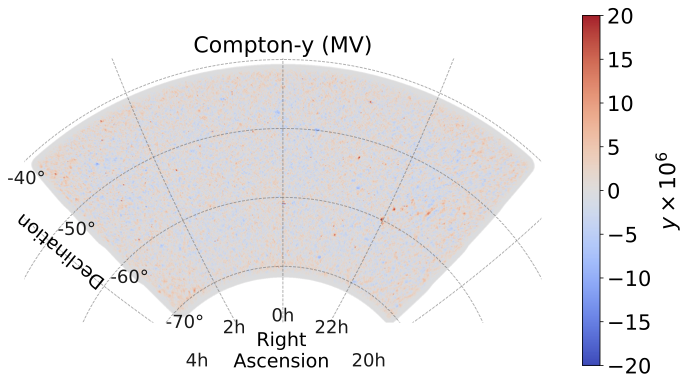
The Planck and SPT-3G combined minimum-variance Compton-y map over the SPT-3G survey field. Numerous galaxy clusters are prominently visible as reddish features resulting from the tSZ effect.
Quadratic estimators for CMB weak lensing
Quadratic estimators are widely used to reconstruct the CMB lensing potential from temperature and polarization maps. We showed that the commonly used Hu-Okamoto (HO02) estimator, which first constructs optimal single-pair quadratic estimators and then combines them, does not yield the absolute minimum-variance result. Instead, we derived the global-minimum-variance (GMV) quadratic estimator, which minimizes the variance of all temperature and polarization combinations in one single step. We demonstrated that the GMV estimator achieves ~9% lower reconstruction noise than HO02 for experiments like the Simons Observatory, and that estimators used in previous Planck and SPT analyses are even less optimal (up to ~11% higher noise than GMV). This work provides motivation for adopting the GMV estimator in future weak lensing analyses aimed at constraining neutrino masses, primordial non-Gaussianity, dark energy, and modified gravity.
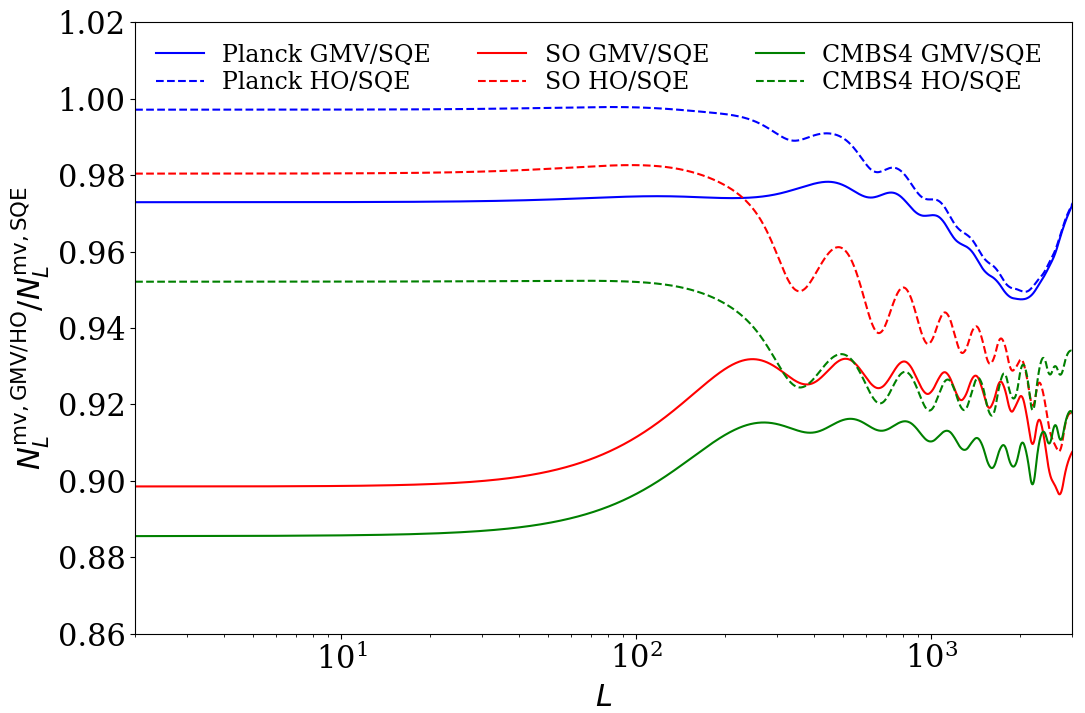
Ratio of the minimum-variance reconstruction noise of the GMV and standard quadratic estimators (SQE), and HO02 and SQE estimators for different experimental setups (Planck, Simons Observatory, CMB-S4). The GMV estimator consistently outperforms HO02 across all configurations.
Constraining cosmology with the CMB and CIB correlation
We explored the use of the cosmic infrared background (CIB) as a tracer of large-scale structure to cross-correlate with the CMB and exploit the integrated Sachs-Wolfe (ISW) effect for constraining dark energy. We derived theoretical predictions for the CIB-CMB cross-correlation at multiple frequencies and performed a detailed signal-to-noise analysis. While the theoretical forecasts showed promising potential under ideal conditions, our realistic analysis revealed that galactic dust contamination significantly degrades the detection capability. We showed that residual dust contamination in observational maps must be cleaned to extraordinarily stringent levels to maintain measurement quality, highlighting an important systematic challenge for future ISW studies using the CIB.