
Abhishek (Abhi) Sanjay Maniyar
Galaxy Evolution
Understanding how galaxies form and evolve across cosmic time is a central question in astrophysics. My work in this area uses the cosmic infrared background (CIB), line intensity mapping, and cross-correlations with galaxy surveys and the CMB to trace the star formation history of the universe and probe the connection between galaxies and their dark matter halos.
Anisotropic screening of the CMB: probing baryonic feedback around galaxies
We searched for the anisotropic screening signal in the CMB—a phenomenon where spatial density variations in ionized gas around galaxies produce secondary CMB fluctuations through Thomson scattering. Using a novel estimator that cross-correlates unWISE galaxies with measurements from the Atacama Cosmology Telescope and Planck, we placed the tightest upper limits on the optical depth around galaxies. While we did not achieve a statistically significant detection, the stacked radial profiles of the optical depth shown below constrain models of baryonic feedback and galactic gas content. We demonstrated through extensive null and consistency tests the robustness of our methodology. Upcoming CMB experiments like CMB-S4 are expected to definitively detect this signal, which will provide powerful insights into galactic feedback mechanisms and the distribution of baryons around galaxies.
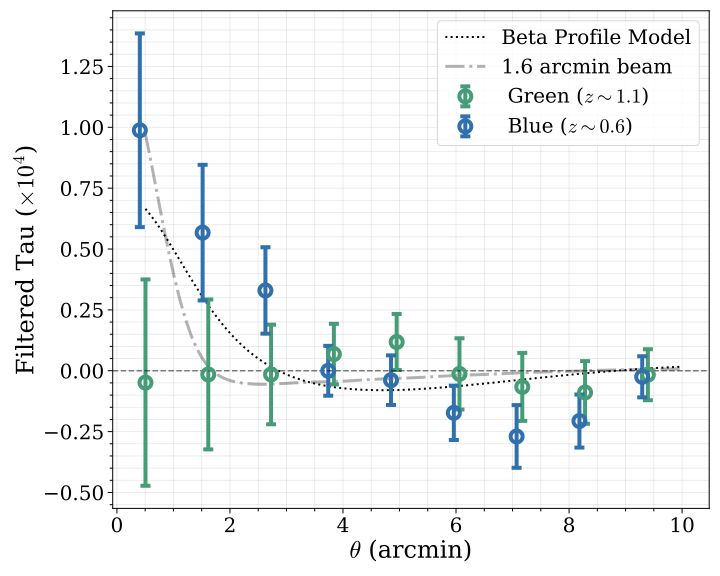
Stacked 1D profiles of the optical depth around the unWISE green and blue galaxy samples, with 1σ error bars. The dotted line shows a beta profile model fit, while the dot-dashed line indicates the expected signal for a point source, both convolved with the beam.
Constraining star formation with joint CIB and [CII] intensity mapping
Line intensity mapping (LIM) experiments targeting emission lines like [CII] also pick up considerable CIB continuum emission from infrared galaxies. We proposed treating this CIB emission—typically considered unwanted foreground contamination—as a complementary dataset that strengthens star formation rate (SFR) measurements. We developed a unified power spectrum model that integrates both the [CII] line and CIB continuum signals under a common SFR framework, and tested it using forecasts for the EXCLAIM experiment. We showed that while current survey capabilities yield modest improvements, future experiments with wider sky coverage and lower noise would substantially benefit from this joint analysis, with the CIB signal helping to break parameter degeneracies that arise from [CII] observations alone.
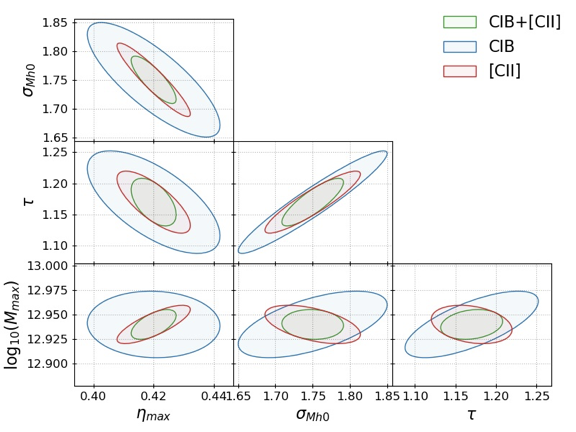
Fisher forecast constraints on star formation rate parameters for a future survey with optimistic sky coverage (fsky = 0.1). The joint analysis of CIB continuum and [CII] line emission (blue) provides tighter constraints than either probe alone, demonstrating the power of combining these complementary signals.
Simple halo model for the CIB and its correlation with the tSZ effect
We developed a streamlined halo model for CIB anisotropies using just four free parameters. At the heart of the model is a lognormal parametrization of the star formation efficiency η as a function of halo mass, which links dark matter halo mass accretion to star formation rates. We found that halos at log10(Mmax) ≈ 12.94 M☉ convert accreted baryonic material into stars most efficiently. Our model simultaneously fits Planck and Herschel CIB data—a first for CIB modeling—and calculates the CIB×tSZ cross-correlation without requiring additional parameters. This work provides a physically motivated, parsimonious framework for understanding the infrared emission from galaxies and its connection to galaxy clusters, with direct applications to CMB foreground modeling.
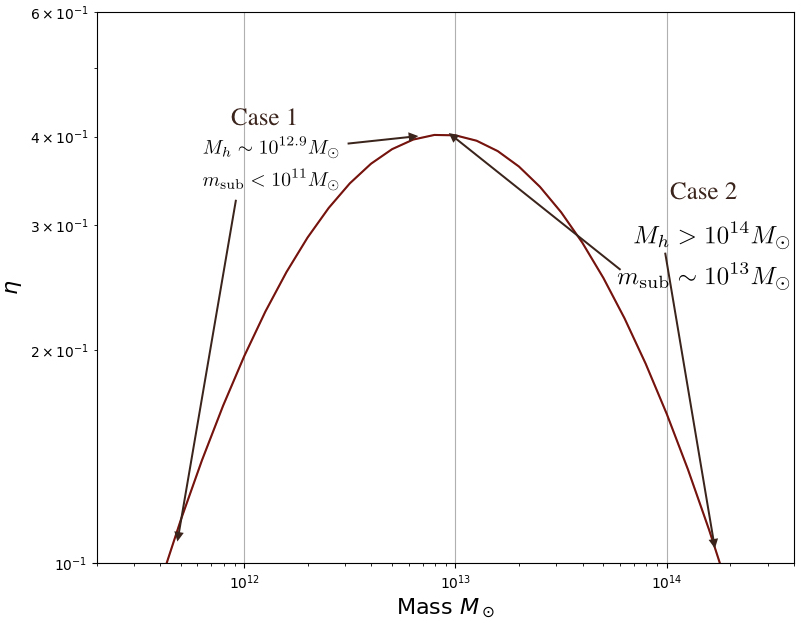
Lognormal parametrization of the star formation efficiency η (ratio of SFR to baryonic accretion rate) as a function of halo mass. The two cases illustrated show how the model handles satellite galaxy SFR in different halo mass regimes, avoiding unphysical values through a minimum-SFR prescription.