
Abhishek (Abhi) Sanjay Maniyar
Novel Tools for the Future
A key part of my research involves developing new theoretical frameworks and observational techniques for current and next-generation experiments. These include identifying previously overlooked signals in CMB data, proposing new cross-correlation probes, and devising methods to access unexplored epochs of the universe using line intensity mapping and gravitational lensing.
Extragalactic CO emission lines: a forgotten foreground in CMB experiments
We demonstrated that carbon monoxide (CO) molecular emission lines from distant galaxies constitute a significant and previously overlooked foreground in CMB experiments. Using the SIDES simulations at 150 and 220 GHz, we showed that the cross-correlation of the CIB with CO lines has a contribution comparable to the CIB×tSZ correlation and the kSZ power spectrum. This is particularly important because recent measurements of the kinetic Sunyaev-Zel'dovich (kSZ) effect by the South Pole Telescope do not account for CO contamination, and our work suggests these estimates may need revision. We also showed that cross-correlating CO emission with CIB maps opens a new avenue for measuring CO properties, and that future CMB analyses must properly account for this previously neglected signal.
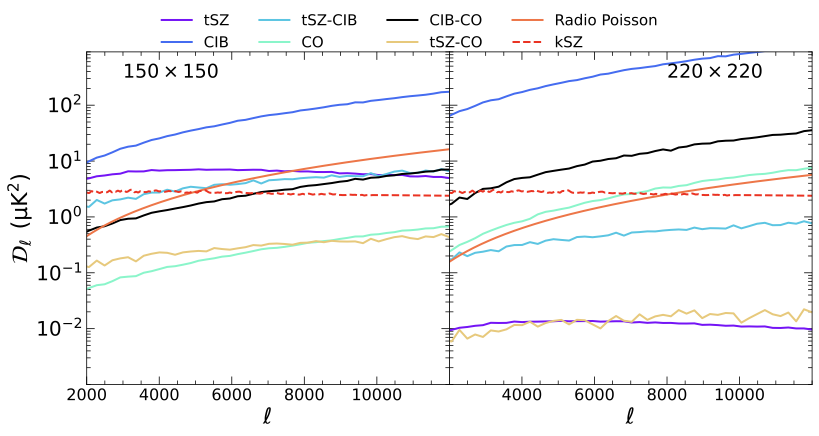
Power spectra of different astrophysical components at SPT 150 and 220 GHz channels. The CIB×CO cross-correlation (red) is a significant contribution at both frequencies—at 220 GHz, it is the second most important signal after the CIB itself.
Doppler boosted dust emission: a new cosmological probe
We identified a new cosmological signal: the Doppler-boosted cosmic infrared background (DB-CIB), arising from the peculiar motion of galaxies whose thermal dust emission sources the CIB. This signal acts as an independent tracer of cosmic velocity fields, analogous to the kinematic Sunyaev-Zel'dovich (kSZ) effect but with a key advantage—it avoids the "kSZ optical depth degeneracy," making it immune to the complex astrophysics of galaxy formation. We showed that upcoming experiments like CCAT-prime and DESI, when cross-correlated, can detect this effect. We also warned that if not properly accounted for, the DB-CIB could contaminate future CMB foreground measurements.
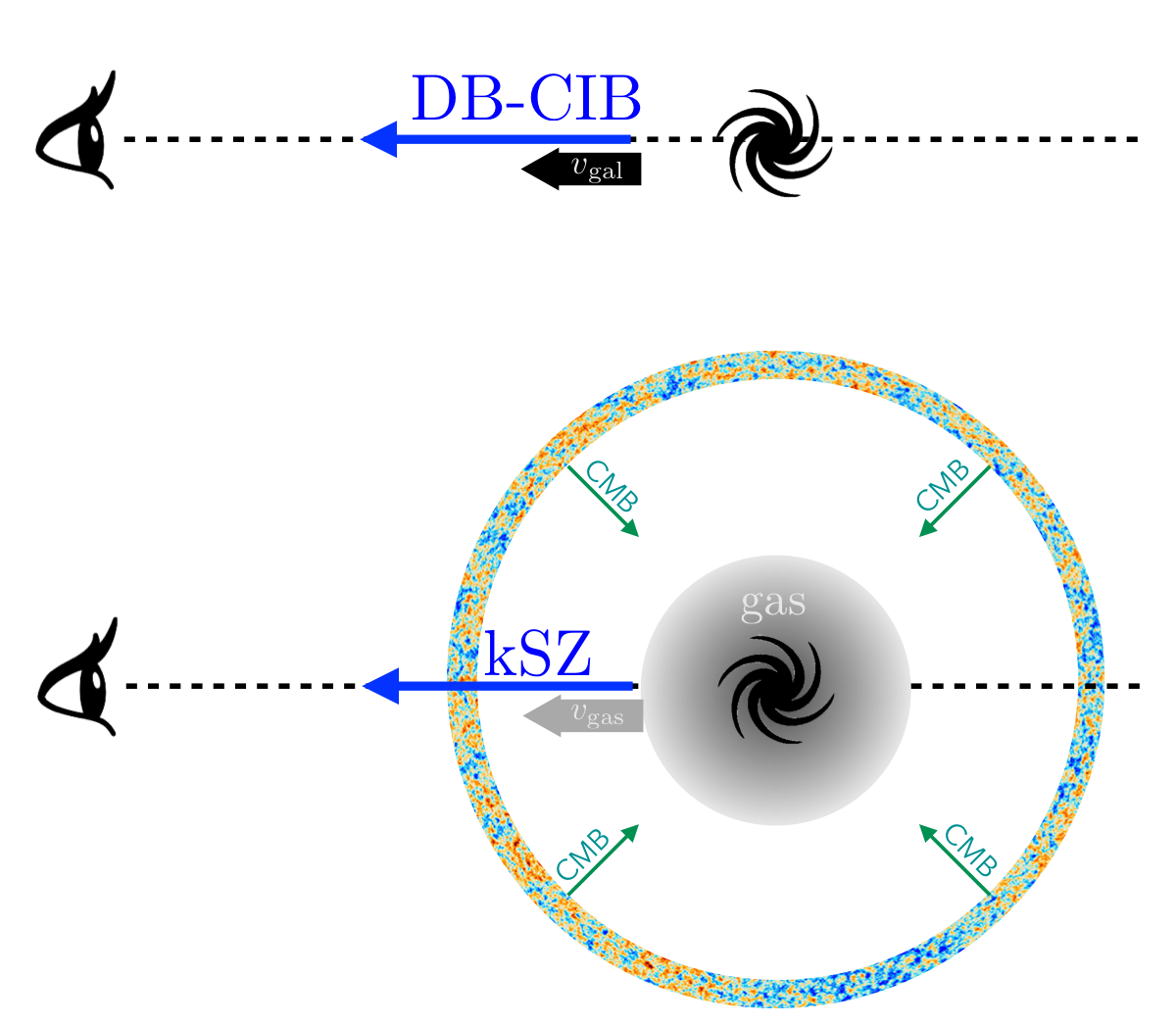
Although the DB-CIB effect is analogous to the kSZ, there is a subtle difference between the two. The kSZ pertains to the Doppler effect of CMB photons scattering off hot intracluster gas, while the DB-CIB is the Doppler effect on the infrared emission from a galaxy with a peculiar velocity along our line of sight. The kSZ is proportional to the optical depth of the hot gas τ, whereas the DB-CIB is insensitive to it, probing the velocity field without the "τ degeneracy."
Nulling CMB lensing with interloper-free "LIM-pair" lensing
We proposed a novel method to probe poorly explored redshift ranges between galaxy surveys and the CMB using line intensity mapping (LIM) combined with gravitational lensing. A major challenge in LIM lensing is contamination from interloper foreground lines. We introduced the "LIM-pair" estimator that eliminates this contamination by cross-correlating two intensity maps at the same redshift but from different emission lines. Since interlopers affect each line differently, this approach avoids interloper bias exactly without relying on uncertain theoretical models. Combined with a lensing nulling technique, this enables clean probes of the high-redshift universe (z > 1) and potentially even the Dark Ages, complementary to 21 cm experiments.
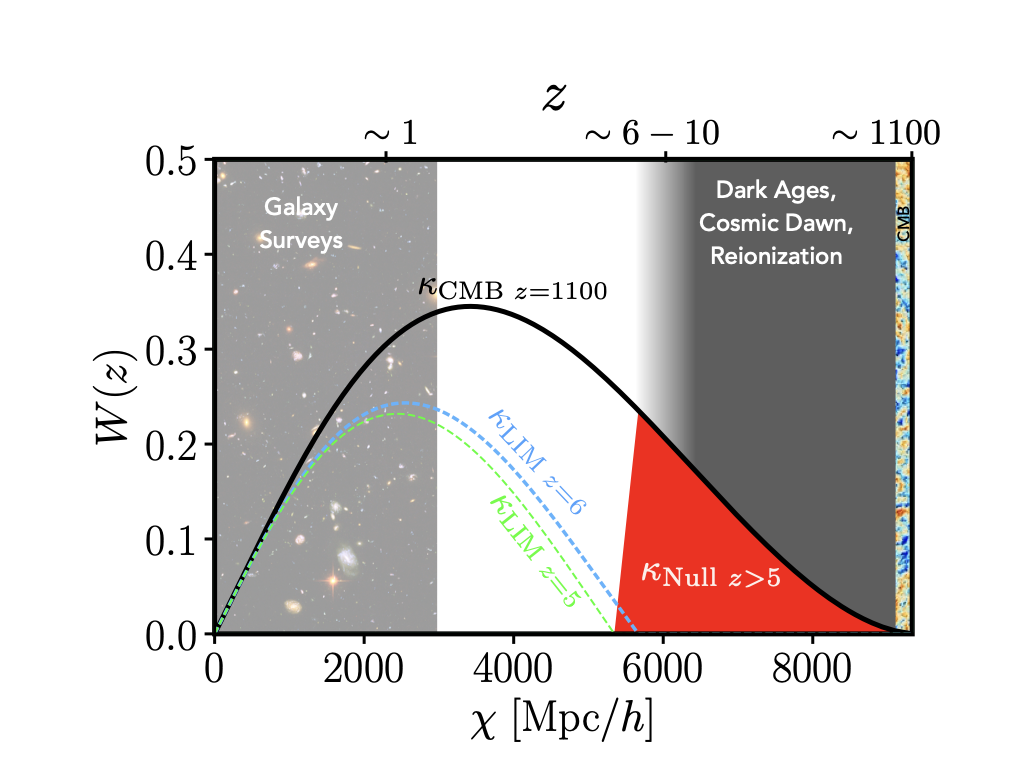
By combining CMB lensing (black) with lensing from two LIM sources at z=5 (green) and z=6 (blue), we construct a linear combination that exactly nulls the low-redshift signal, isolating the lensing kernel sensitive only to z > 5 (red shaded region). This offers a new probe of the Dark Ages, Cosmic Dawn, and Reionization, complementary to 21 cm experiments.